No idea what’s for dinner tonight? 7 go-to tricks that save the day
That famous moment of staring blankly into the fridge at 6pm, everyone knows it. Here are 7 simple reflexes so you never get stuck in front of the fridge again.
What should you eat tonight when you have absolutely no idea?
The most effective trick is to start from what’s already in the fridge and the pantry, then build the meal around a single building block, the protein, the vegetables, or the starch. No need to invent a complicated recipe, a simple meal with a bit of each food family is plenty. With a few minutes of organized thinking, dinner anxiety disappears.
Why do we end up with no ideas so often in the evening?
It’s almost always a matter of decision fatigue. After a day of work, commuting, and checking homework, there’s no mental energy left to pick a dish among hundreds of possibilities. The brain hits a wall and everything seems equally complicated, even a simple veggie stir fry.
The good news is that this block gets solved with automatic habits rather than willpower. Here are the seven that really work, night after night.
1. Look in the fridge before looking at a recipe
Before searching for inspiration elsewhere, open the fridge and do a quick inventory. Some leftover rice, a handful of slightly tired spinach, two eggs, that’s already a meal in the making. This habit avoids buying duplicates and limits waste, a concern that’s far from trivial at the scale of French households.
In France, households produce a major share of the country’s food waste, since the food chain generates a total of 9.7 million tons of waste every year, a significant part of which is still edible food. Cooking with what’s on hand isn’t just practical, it’s also a gesture that matters on a national scale.
How do you turn leftovers into a real meal?
Leftover cooked vegetables become the base for a soup or a gratin. Leftover starch gets reheated in a pan with an egg and a few frozen vegetables. The idea isn’t to follow a recipe to the letter, but to build on what already exists to get a complete dish.
2. Think in building blocks rather than ready made dishes
Rather than searching for a specific dish, think of your plate in three or four simple building blocks, a protein, a starch, vegetables, a bit of fat. This visual method is widely recommended by official dietary guidelines.
A simple benchmark is to balance your plate with half vegetables, a quarter starches, and a quarter protein, meat, fish, egg, or legumes for vegetarian meals. With this breakdown in mind, you just have to pick one item from each category to get a coherent dinner, even without inspiration.
Do you really need to respect these proportions every evening?
Not at all, and that’s exactly what makes the method so relaxing. What matters is eating a bit of everything, varying your diet, and adjusting quantities to your activity level rather than aiming for perfection at every meal. A pasta night without vegetables isn’t a disaster if the next day’s lunch brings more of them.
3. Keep an emergency stash always ready
Having a few cans of legumes, frozen vegetables, and eggs at home means you’re never truly stuck. Dried legumes cook in just a few minutes once drained and rinsed, and they bring both protein and fiber.
France’s national health insurance recommends regularly eating legumes, lentils, broad beans, or chickpeas, at least twice a week, alongside meat or fish, or in their place when paired with a grain product. A jar of chickpeas combined with frozen vegetables and a bit of spice makes a complete dinner in under twenty minutes, with nothing planned ahead.
Are frozen vegetables a good option for an improvised dinner?
Yes, absolutely. They’re washed, cut, and ready to cook, which saves precious time on a tired or lazy evening. Keeping several varieties in the freezer lets you vary colors and flavors without having to plan grocery shopping ahead.
4. Choose a cooking method that works while you do something else
Dishes that simmer on their own, covered in a pan, in the oven, or in a Dutch oven, free up time to look after the kids, answer a message, or simply catch your breath for five minutes. This habit lightens the mental load of dinner, since cooking moves along without constant watching.
Which dishes need the least attention?
Gratins, foil packets, and simmering sauced dishes are perfect for this. Just prepare the ingredients, start the cooking, and go about other things while keeping an occasional eye on it.
5. Vary your protein sources so you don’t go in circles
When you’re short on ideas, you tend to make the same thing over and over. Mentally widening the list of possible proteins, eggs, fish, legumes, poultry, tofu, helps break out of that rut and brings back the desire to cook.
Varying textures and colors on the plate also makes the meal more appealing for the whole family, with no extra prep effort.
6. Round it out with fruits and vegetables, even very simple ones
An improvised dinner doesn’t need to be perfect, but adding an extra piece of fruit or vegetable, even a basic one, contributes to the day’s overall balance. Official guidelines highlight the importance of this daily presence.
The official guideline encourages eating fruits and vegetables at every meal and for snacks, with the equivalent of at least five portions a day. A tomato salad as a starter, a piece of fruit for dessert, and the box is checked with no extra effort.
Do canned or frozen vegetables count toward these portions?
Yes, and that’s great news for busy evenings. Fresh, frozen, or canned, fruits and vegetables count the same way toward daily intake guidelines. No need to peel pounds of fresh vegetables to do things right.
7. Accept that a simple dinner is a good dinner
The last habit, and probably the most freeing one, is letting go of the idea that dinner has to be elaborate to be a success. An omelet with a salad, pasta with leftover vegetables, or a homemade soup is plenty for a weeknight.
This is exactly the spirit in which Mon Chou supports everyday meals, suggesting dinner ideas tailored to everyone’s tastes at home and to what’s left in the fridge, without ever making anyone feel guilty for keeping it simple.
In short, how do you stop getting stuck in the evening?
Check the fridge before looking for a recipe, think in building blocks rather than fixed dishes, keep an emergency stash, choose a cooking method that works on its own, vary your proteins, add a bit of fruit or vegetables, and above all embrace simplicity. Taken together, these seven habits turn the most dreaded moment of the day into an almost peaceful one.
Frequently asked questions
What should you do when there’s almost nothing left in the fridge?
Rely on pantry basics, pasta, rice, canned legumes, eggs, which pair easily with leftover frozen vegetables. A drizzle of olive oil and a spice are often enough to turn three simple ingredients into a real meal.
Is it a problem to eat simply every other evening?
No, a balanced diet is built over the course of a week, not a single meal. A simple dinner rounded out with fruits and vegetables is perfectly sufficient for everyday health.
Are frozen vegetables as good as fresh ones for a quick dinner?
They count exactly the same way toward recommended fruit and vegetable portions and save precious time, since they’re already washed and cut. It’s a practical solution for evenings when prep needs to be quick.
Sources
- Assurance Maladie (Ameli), Les féculents et les légumes secs (légumineuses), 2024, ameli.fr
- ADEME, De la fourche à la fourchette, les déchets alimentaires s',accumulent, 2024, infos.ademe.fr
- ADEME, Comment traquer le gaspillage alimentaire ?, 2024, librairie.ademe.fr
- ADEME, Gaspillage alimentaire, près de 250 foyers ont économisé l',équivalent de 21 400 repas en 1 an, 2023, ademe.fr
Mon Chou's dishes to go further
 Vegetarian
 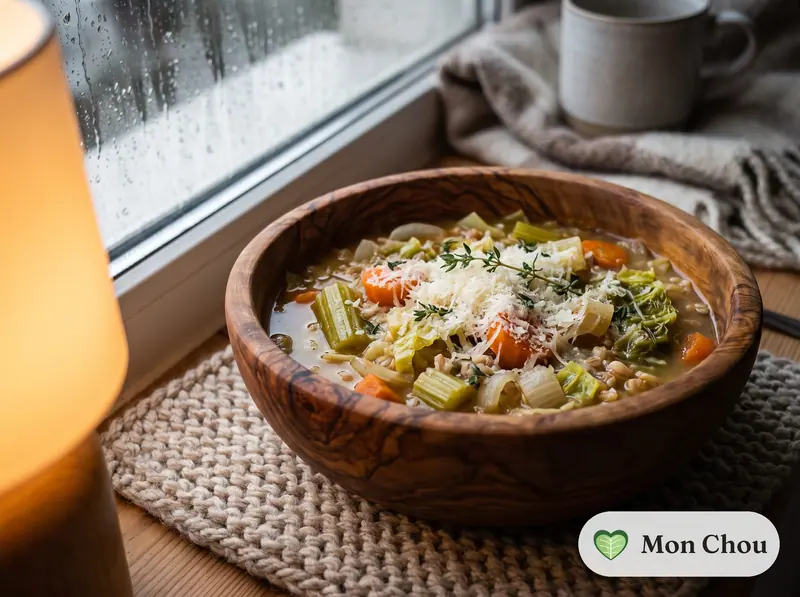 Vegetarian
 Winter vegetable and farro soup with parmesan
1 h Very easy €1.50 / person
550 kcalcalculated by Kiloach
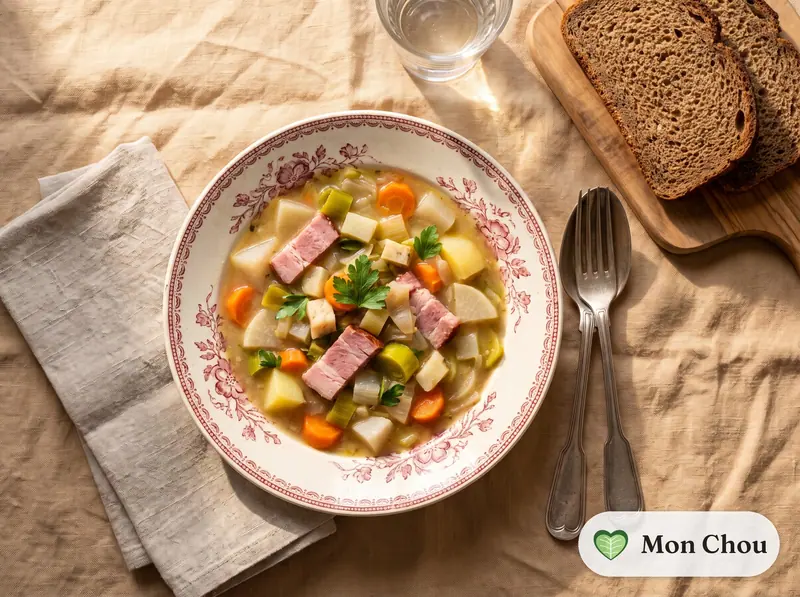 Meat
Meat Winter vegetable soup with ham and rye bread
45 min Very easy €2.00 / person
650 kcalcalculated by Kiloach
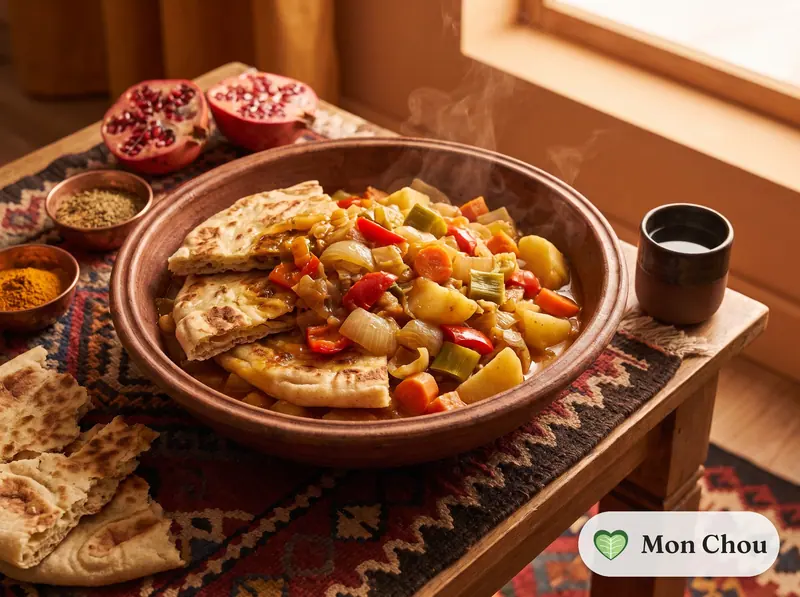 Vegetarian
  Vegetarian
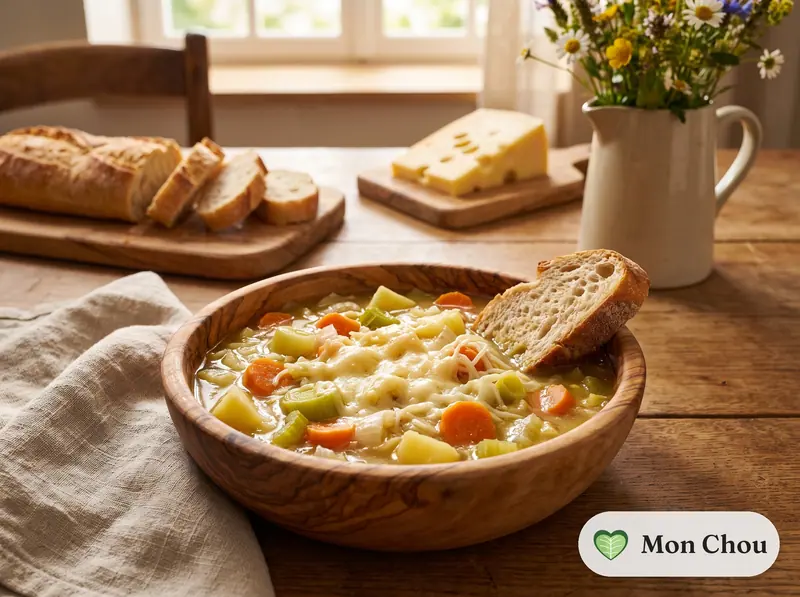
 Vegetable soup with vermicelli and grated cheese
35 min Very easy €1.40 / person
530 kcalcalculated by Kiloach
 Vegetarian
 Farmhouse vegetable soup with cheese croutons
50 min Very easy €1.20 / person
420 kcalcalculated by Kiloach